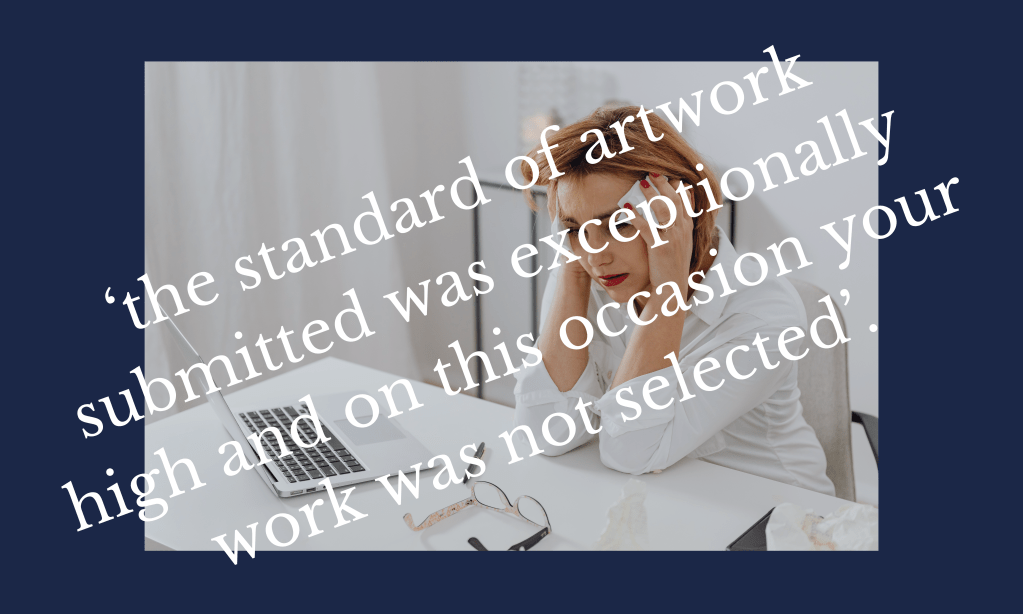
You’ve created an artwork, got it photographed beautifully, framed tastefully and then sent it out onto the open calls to see what people think. Then that email lands, the one that says ‘no’. It can be really tough to process the rejection when you’ve given your all.
I’ve been privileged to work in a selector role for exhibitions and it was an eye-opening experience. Seeing the submission process from both sides has given me more perspective on the multiple rejections I receive each year. Here are a few of the reasons why excellent work doesn’t get selected for art shows:
- It doesn’t fit with the exhibition theme
- It’s the wrong size
- It looks a lot like someone else’s work
- The artwork doesn’t align with the sponsors
- You have other artworks in the exhibition

1. It doesn’t fit with the exhibition theme
Let’s break this down. The exhibition is advertised as being about ‘blue paintings’ so you’ve submitted your best blue painting. When it doesn’t get accepted you feel thwarted. Take a breath. There are often sub-themes that a selector is focusing on. Every curator, judge or selector has their own set of interests. Take the ‘Blue Paintings’ show, the selector wants to focus on highlighting issues around wildlife, this is a sub-theme for the show. In this case all the blue paintings they select will reflect their passion for wildlife. You could submit the best painting ever of a fire station, but it doesn’t fit with the selector’s interests so it won’t get into the show.
Even with careful research into the selection panel an artist cannot always predict what the sub-themes will be. If the artwork doesn’t match the interests of the selectors it will not be accepted into the art show.
2. It’s the wrong size
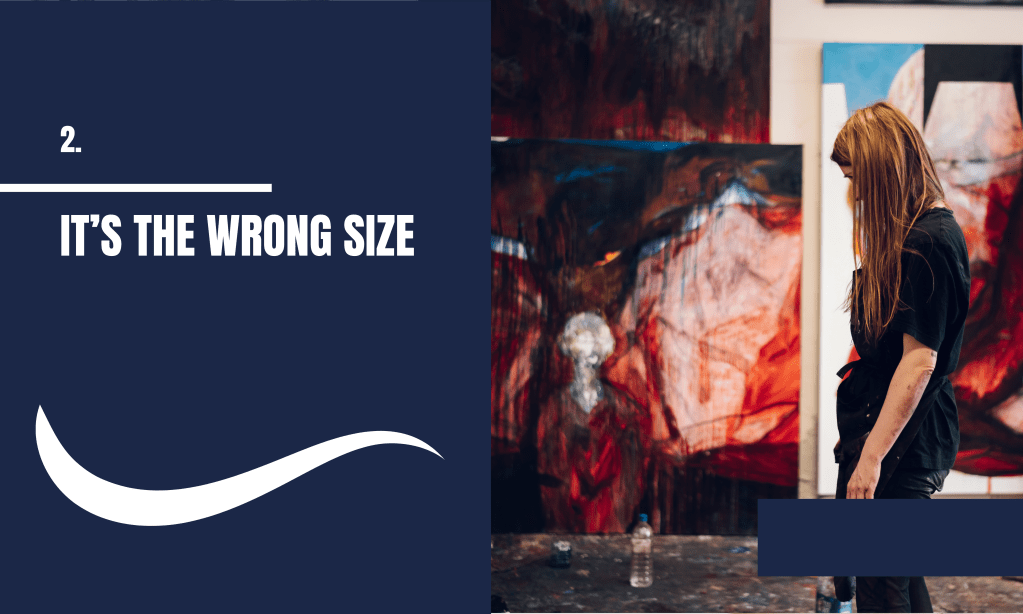
Every exhibition has guidelines on what size works can be submitted, which, of course, you have followed to the letter. Often artists assume that bigger artwork has more chance of being selected. It’s true that usually exhibitions use large pieces as centre points, surrounded by smaller artworks. Having said that, every exhibition venue has a finite amount of space. The selector may love your big artwork but if they’re running low on space they cannot take it. Open Exhibitions are designed to include lots of artists. It helps market the show and gives more artists the opportunity to exhibit in prestigious venues. Every time a large work is accepted that means two or three smaller works are rejected. If you submitted a big artwork that didn’t get in, it’s likely space is at a premium.
Conversely, very small work can also suffer, particularly in physical selection processes. If the selectors have only 5 seconds per work to decide, smaller works may simply be overlooked due to lack of time to get up close. This is thankfully less of an issue now that selection is primarily digital. The exhibition has to appear harmonious and very small artwork can be difficult to hang next to standard sized works. If you work at a miniature scale framing multiple works together in a standard sized frame can reduce this pain point for the exhibition team and increase the chances of an acceptance.
3. It looks a lot like someone else’s artwork
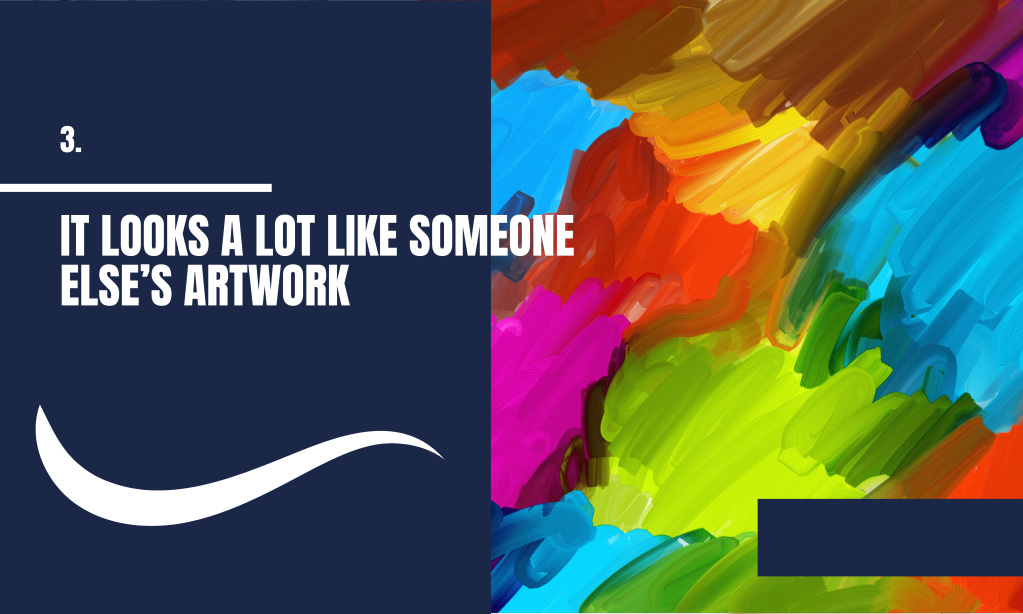
Sometimes you’ll submit work for a show which will be thematically or visually similar to other artists submissions. For example, you submit a stunning charcoal landscape of a mountain range. Unbeknown to you, two other artists have also produced beautiful charcoal landscapes of mountain ranges. Imagine this, the selectors have three equally amazing pictures all on the same subject in the same medium. Exhibitions need variety, so they decide to choose just one of the three pictures.
At this point to help the decision the selectors might read through you Artist CV, Bio or artwork description. Perhaps they’re in a rush and they simply pick the one they saw first or take a vote on which one to choose. Either way, it is not a reflection on the quality of the artwork. If you see an artwork that is visually similar to your own submission in the final exhibition, there’s a good chance this is the reason for the rejection.
4. The artwork doesn’t align with the sponsors
Exhibition sponsors and venues have their own ideas. For example, a sponsor with a commitment to sustainability might ask the art show selectors not include artworks created using non-recycled plastics. If you submit an artwork created using new plastic it will not be accepted, no matter how accomplished it is. In addition to the sponsors the exhibition venue has a right of veto. If an exhibition venue is unhappy with a selected work because they think it will garner bad press they can ask for it to not be included in an exhibition. An example of this would be a family friendly venue requesting that adult themed art is not included in the art show.
5. You have other artworks in the exhibition*
When you submit multiple artworks it’s totally normal to have some of them rejected. That doesn’t mean you don’t still feel a tiny bit sad that your favourite piece didn’t get in. It’s still painful when works don’t get accepted, especially when you can’t publicly admit to feeling disappointed because it looks like sour grapes. While you’re celebrating the work that did get accepted remember that the idea of Open Exhibitions is to include lots of artists. It is a very rare, highly commendable achievement to have multiple works selected for the same show.
*but I only submitted one artwork…
I get it, submitting multiple artworks to Open Calls quickly becomes expensive. It’s typically around £15 per entry. If you’ve only submitted one artwork it is even harder when it’s rejected. You feel like it’s a personal attack on your artistic ability. It isn’t. Honestly, think about it, if you’d have put three works forward maybe one of the other two would have been a perfect fit.
Top Tip: Focus on exhibitions that are aligned with your practice. Sending three entries to an opportunity that fits is a better use of time and money then submitting three different entries to exhibitions that don’t quite match up.
You need a strong, resilient streak to be an artist. Whenever a rejection shakes your faith dig into that ferocious, fearless creative soul of yours. It may be surprising to learn that even established artists deal with rejection. Ultimately, there are so many reasons that a selector might say ‘no’ to excellent artwork. These are just five of them. Keep making work, keep sending it out into the world and above all keep the faith. I’d love to hear about your experiences on the roller coaster of Open Exhibitions, drop a comment below to tell me how you handle it.
REFERENCE LINKS
Advice on how to increase your chances in Open Calls
Images from Home – Canva
Links to artist opportunities in the UK (I am in no way affiliated with these organisations):
Artist Opportunities – Parker Harris
Home – a-n The Artists Information Company
Opportunities (artquest.org.uk)
CHARLIE KIRKHAM NEWSLETTER
Sign up for free and be the first to get notified about updates.
 Charlie Kirkham
Leave a comment